 Oracle 23c New Features for DBA's
Hello All
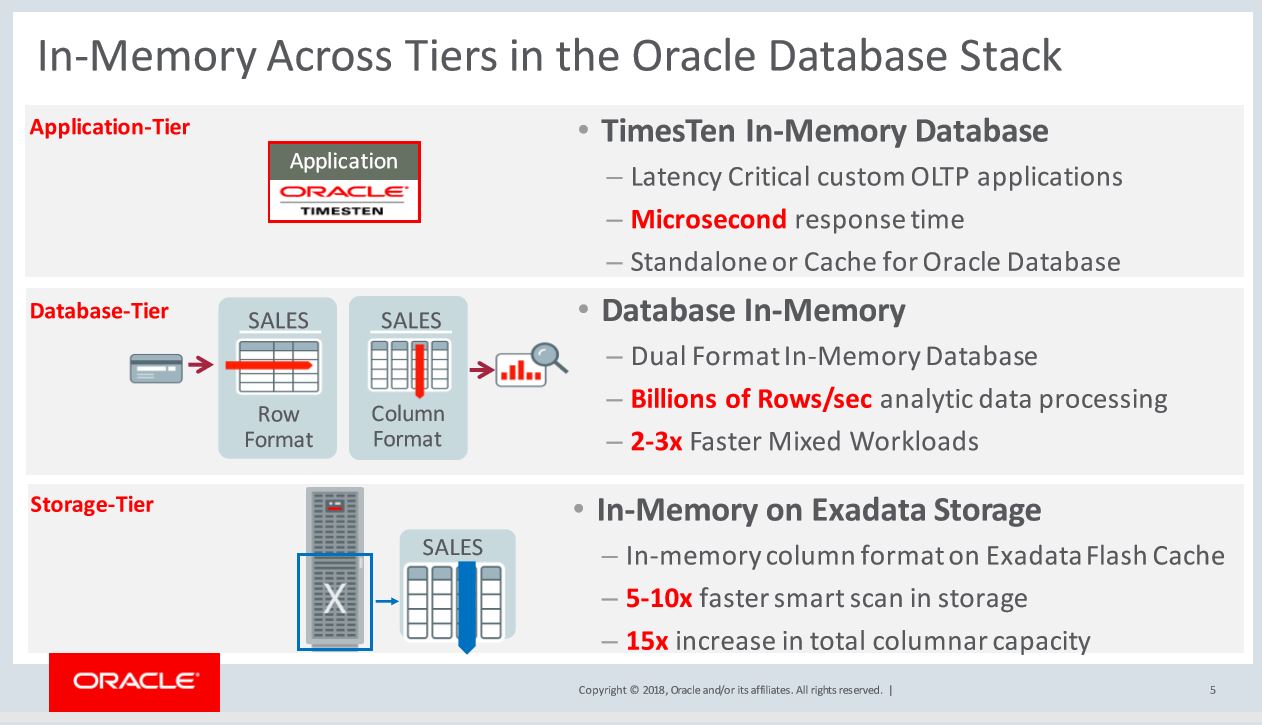
One of the #OOW18 presentations slides on In Memory by @TirthankarLahari @dbinmemory and Oracle In Memory features across tiers explained. And listen more from him @sangam18 , #sangam18, @aioug at Bengalure 7th and 8th.
Thanks
Suresh
|
||||
|
Hello All One of the #OOW18 presentations slides on In Memory by @TirthankarLahari @dbinmemory and Oracle In Memory features across tiers explained. And listen more from him @sangam18 , #sangam18, @aioug at Bengalure 7th and 8th.
Thanks Suresh
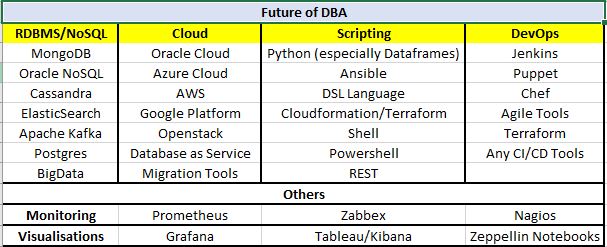
In constant pursuit of human race behind technology with all due respect of it this post dedicated to all those of like mine. Often I (in fact everyone of reading this) am been asked a question , what is future of DBA with cloud, autonomous etc. Well that's not for only DBA's its every where, BA/BI roles has been renamed as Data Scientists and Server Admins already adopted Infrastructure as Code with advent of cloud etc. And some of our folks already been working in BigData or NoSQL classified them as Data Engineers (Build/Run/Maintain clusters). So its time for rest of folks to look at that aspect. We may no more been called DBA's ( do not know even what we will be called in next 5-10 years). I remember Arup Nanda blogged long time back when Exadata is on its way and he written DBA's as DMA's. So lets wait someone let call us something 🙂 Back to question, "Future of DBA", surely its not any more a single technology it should be multifold, I tried to put it in on my own way below as separate quadrant and they are equally important, so that I track my self am I covering what Industry has been. We need to learn (constant pursuit of human race behind technology) a lot, indeed its not a mid career switch infact its beginning. Those who already started that's good if not its time to start. Of course, the list below are latest buzz in industry now, when we actually learn and try to apply they may fade away (or not). But let's start one in each one this quadrants. You don't need to mastered but you will need to be enough knowledgeable to run the things. (as IT Operations has only thing to do is Run the Business)
I have not added the Virtualisation/Hypervisor in the list, since they are different from what above. So ideally this is it Containerization and Virtualization play vital role in building microservices, so it will be helpful if you start learning how Docker Container works and tools like kubernetes etc. Hope this helps Happy to take questions on this 🙂 Thanks Suresh From 18c Onwards, we can enable Lost write protection for data blocks which occurs when an I/O subsystem acknowledges the completion of the block write even though the write did not occur or when a former image of the block overwrites the current image. We can enable the Shadow Lost Write protection at Database, Tablespace, DataFile level for which a shadow tablespace is required. As per documentation,
First create a tablespace to track the data blocks reads.
Enable Lost Protection at database level
Enable Lost Protection for pluggable database Level
Enable Lost Protection at tablespace level
Enable Lost Protection at Datafile Level
Enable Lost protection at specific pluggable database datafile level
As such the SCN are compared and when you have load intensive databases running, anticipate some overhead with this. I really did not tested this one. Thanks Suresh Thanks to my Colleague Jaipal to introduce me to this Metalink Note: Doc ID 2005729.1 In a 12c and higher environment, to migrate data between systems that have different endian formats, with the least amount of application down time. The first step is to copy a full back up from the source to the destination. Then, by using a series of incremental backups, each smaller than the last, the data at the destination system can be brought nearly current with the source system, before any downtime is required. This procedure requires down time only during the final incremental backup and the meta-data export/import. The high-level steps for Cross Platform Incremental Backup are:
3. Roll Forward phase (source data remains online - Repeat this phase as many times as necessary to catch destination datafile copies up to source database)
4. Transport phase (source data is READ ONLY)
Thanks Suresh Yes, Oracle always strive to integrate latest trends in the industry to its Database. Now the new one is Kafka integration with Oracle Database through DBMS_KAFKA package. Where you can publish events and consume or load data into tables. This feature has been discussed in CodeOne 2018 by Melli Annamalai, Senior Principal Product Manager at Oracle as per Lucas blog post. Awaiting to see the feature and get hands dirty on it. Very recently I am into a project where I have to publish events back to Oracle database and I am using much of work around solutions. :). This will help Read full article directly from Lucas Jellama's post
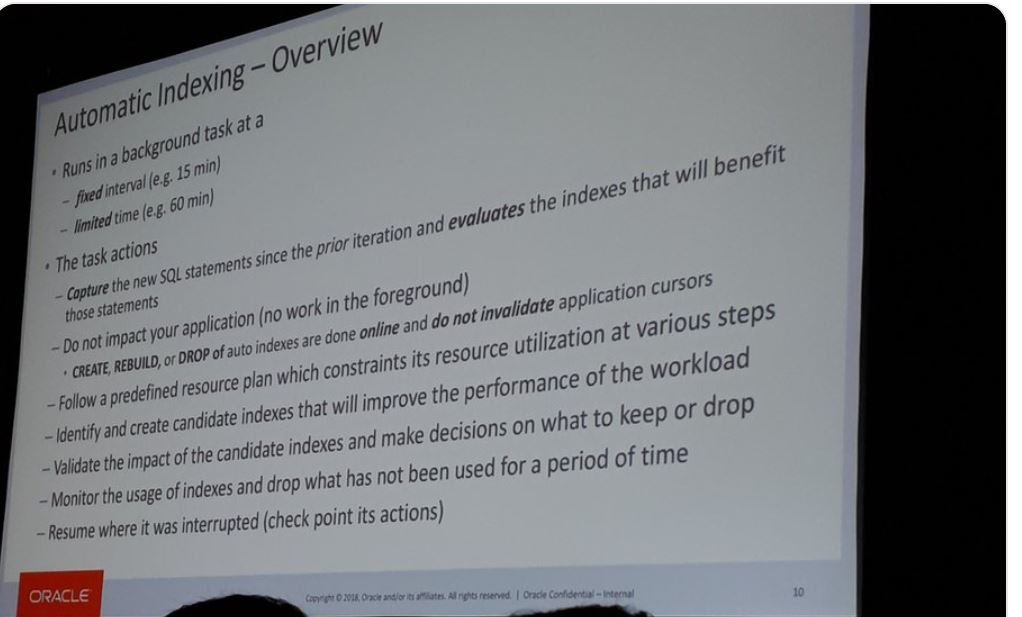
Thanks Suresh Really???. Straight from the OOW#18 updates in Twitter, LinkedIn, various posts. Here is the snippet I got it from twitter from Franck Pachot & Maria Colgan posts. This is how it may/will works :). Runs as background task at Fixed and Limited time. "Do not impact your application" ??? True, read below, Follow a predefined resource plan which constraints its resource utilization means its intelligent enough to do or not to do. if you have a resource plan. 19c Beta seems to be released next week, lets wait for more updates from Oracle Geeks and Gurus.... BTW I have added a new category to my posts now :). Keep going Oracle !!! Cheers.
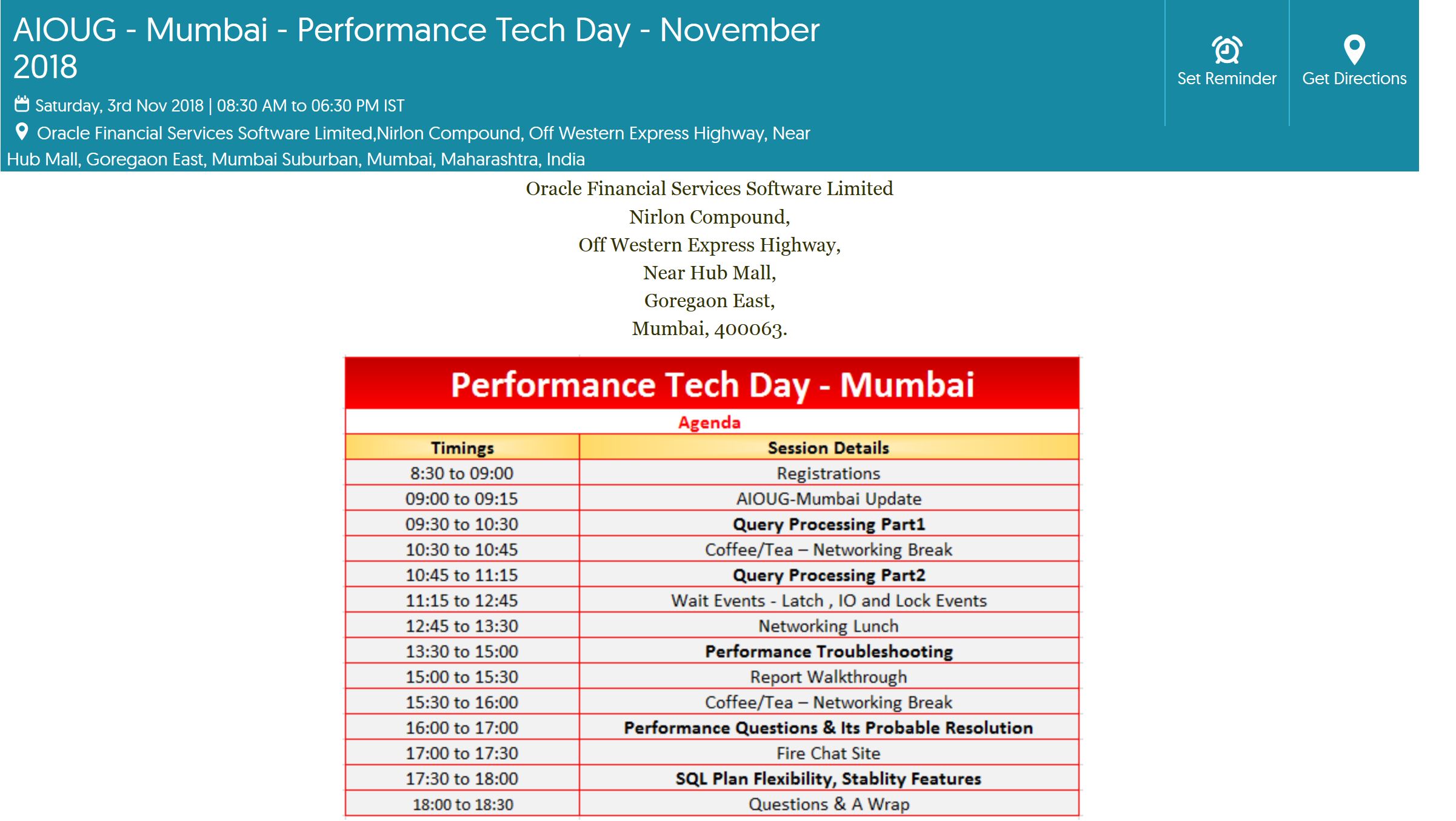
Hello All Are you around Mumbai, India? I am delivering a Full Day Event is planned in Mumbai on 3rd November about Oracle Performance Tuning, Please join with me and session abstracts and registration details can be found in link below. https://www.meraevents.com/event/aioug-mumbai-performance-tech-day-november-2018 Hello All My Latest presentation on Building Datalake in Oracle Cloud, covers at least 6 services in oracle cloud and 4 patterns of datalake editions in Oracle Cloud.  Loading...
Also uploaded videos to my youtube channel which are embedded in the pdf presentations. [embedyt] https://www.youtube.com/embed?listType=playlist&list=PLR6rN4cTV4BTcDAeqZmFdXMijlBu65kxc&layout=gallery[/embedyt] -Thanks Suresh Hello All I am speaking about Datalake in Oracle Cloud in two events as below. I will be covering the fundamentals and building blocks of datalakes and how they differ from datawarehouse, I will also demo the new generation datalake in Oracle Cloud by using BigData, Event HubService & Object store. Hyderabad - Tech Mahindra Campus - 25th Aug 2018 - AIOUG Cloudathon Techday https://www.meraevents.com/event/aioug-hyderabad-august-2018-oracle-cloud-cloudathon-techday
Free Webinar - 27-Aug-2018 - APACOUC - Webinar Tour 2018 See you all in the events. -Thanks Suresh |
||||

 Reload document
  Open in new tab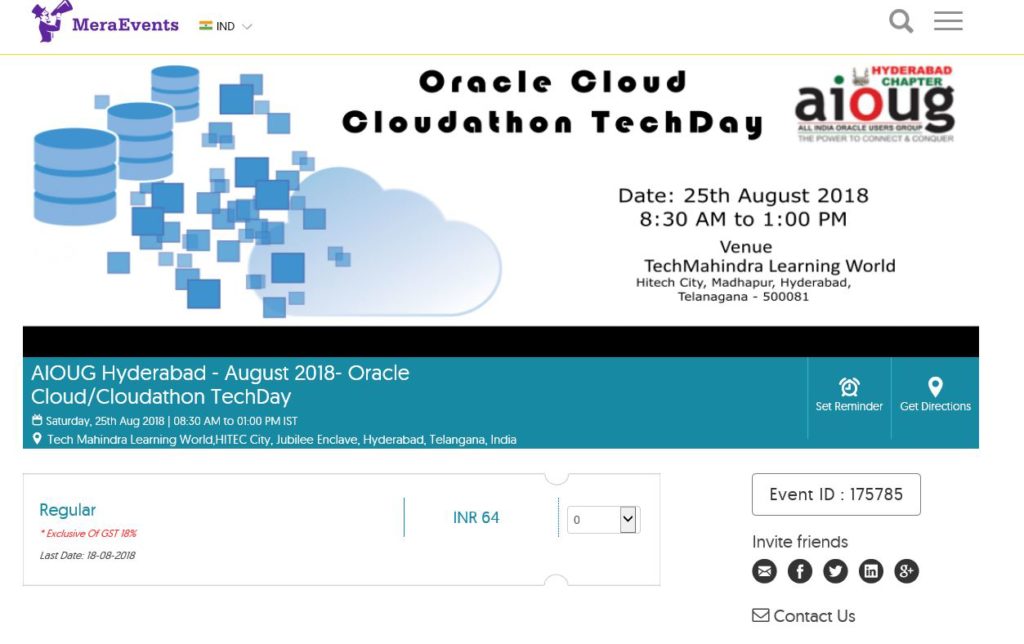
Follow Me!!!